Simons’ Strategies: Renaissance Trading Unpacked
Jim Simons helped establish a model of trading built around data, mathematical research, and systematic execution. Renaissance Technologies describes its business in those terms on its official website. Its public history offers useful lessons, but its proprietary signals, portfolio construction, and current trading systems are not a public recipe.
The practical takeaway is to turn a hypothesis into measurable rules, check the data, account for costs, and control risk. Reported Medallion performance should not be treated as an expected return for quantitative trading—or for an AI-generated strategy.
- Research: distinguish a repeatable signal from an attractive historical coincidence.
- Portfolio construction: assess how positions interact, including leverage and common exposures.
- Execution: a small apparent edge can disappear after spreads, slippage, financing, and market impact.
- Human judgment: researchers remain responsible for assumptions, testing standards, and decisions about deployment.
Renaissance Technologies: Company Origins
Jim Simons: From Mathematics to Trading
According to the Simons Foundation’s account of his career, Simons worked in geometry and cryptography and led Stony Brook’s mathematics department before leaving academia in 1978 to start Monometrics. The business became Renaissance Technologies in 1982. Its research culture drew on mathematicians, physicists, and computer scientists, with collaboration central to the approach.
That history illustrates the value of combining different technical skills. A trading research team needs people who can question a hypothesis, maintain data, write reliable software, assess risk, and examine execution. Hiring a scientist or adding an algorithm is not by itself an investment advantage.
Hear Simons Describe His Approach
In this TED interview with Chris Anderson, published on TED’s YouTube channel on September 25, 2015, Simons discusses mathematics, finance, and his career. It is a primary-source conversation about his perspective, not a disclosure of Medallion’s trading code or current positions.
What Renaissance Has Publicly Described
In a July 2014 Senate hearing statement, Renaissance representatives described using public information such as quotes, trades, filings, and news to make price predictions. They said different funds used different strategies and described Medallion predictions as profitable only slightly more often than not. These are dated descriptions from the firm, not a complete model specification.
Quantitative investing can involve many holding periods. It is not synonymous with high-frequency trading, and systematic research does not require a millisecond execution strategy. The distinction matters when comparing institutional infrastructure with retail algorithmic trading workflows.
Medallion Fund: Read the Performance Carefully
Bradford Cornell’s December 2019 paper reproduces historical figures from Gregory Zuckerman’s book. These are reported results, not a newly audited track record. Cornell analyzes gross returns after trading costs but before fund fees.
| Measure | Reported figure |
|---|---|
| 1988–2018 arithmetic annual average | 66.07% gross; 39.20% net |
| 1988–2018 compounded annual gross growth | Approximately 63.3% |
| 2008 | 152.10% gross; 82.38% net |
| 2009 | 74.60% gross; 38.98% net |
| 1989 | 1.00% gross; −3.20% net |
| 2002–2018 fee schedule in the table | 5% fixed fee; 44% performance fee |
The paper’s hypothetical $100-to-$398.7-million gross compounding calculation assumes reinvestment that capacity restrictions and distributions could prevent. It is not an actual continuously reinvested investor balance. “Never lost money” is also misleading: the table includes a negative net year.
Cornell reports an approximately −1 market beta in an annual regression. That is a sample estimate, not proof of zero risk or a dependable hedge. His draft also contains inconsistent year and benchmark labels; avoid treating every headline comparison as precise. Medallion and Renaissance’s outside-investor funds are distinct products.
What Performance Statistics Do—and Do Not—Show
An arithmetic average answers a different question from compounded growth. For example, a 50% gain followed by a 50% loss has a zero arithmetic average but leaves $100 at $75. Always label gross or net, frequency, date range, and the assumptions behind reinvestment.
A Sharpe ratio requires excess returns over a risk-free benchmark and a consistent estimate of their variability. Dividing a raw average return by raw-return volatility is not automatically the same calculation. Annual observations can also hide substantial losses within a year, financing stress, and changes in exposure.
A striking historical track record invites investigation; it does not establish that a particular publicly discussed indicator caused the outcome. Nor does one exceptional fund demonstrate that systematic strategies generally beat discretionary investors. Access restrictions, capacity, data, and execution are part of the context.
Quantitative Methods: Useful Concepts, Not Disclosed Secrets
Data Analysis and Signal Research
A quantitative hypothesis describes a relationship that can be evaluated using information available at the time. For example: does a price deviation tend to reverse over the next few sessions after specified liquidity and volatility conditions? Define the signal, universe, horizon, entry time, and costs before looking for favorable results.
Clean data is more than a long price history. Check timestamps, exchange calendars, missing observations, corporate actions, delisted securities, and when financial information actually became public. Data revised later must not silently replace what a strategy could have known during its historical test.
The QuantConnect research guide explains common research biases, including survivorship and look-ahead. A strategy tested only on today’s successful companies can benefit from hindsight even when every formula is coded correctly. Testing many alternatives and publishing only the winner creates another selection problem.
Small Edges Need Payoff and Cost Analysis
A win percentage alone cannot establish profitability. In a hypothetical strategy winning 50.75% of the time, with equal $100 wins and losses, expected profit is 0.5075 × $100 − 0.4925 × $100 = $1.50 per trade before costs. If average all-in costs are $2, expectancy becomes −$0.50. This example illustrates arithmetic, not Renaissance’s actual trade economics.
Unequal payoffs change the conclusion too: a lower win percentage can be profitable with larger average winners, while a high hit rate can conceal rare, severe losses. Evaluate payoff distributions, losing streaks, turnover, and the number of genuinely independent observations.
More trades do not automatically remove risk. If positions share the same signal, sector, financing source, or liquidity shock, their losses can occur together. A million highly dependent observations do not offer the same evidence as a million independent trials.
Market-Neutral Trading and Statistical Arbitrage
HFR’s strategy classifications describe market-neutral approaches as seeking limited exposure to broad market direction. Long and short positions can help achieve that aim, but equal dollar amounts do not necessarily neutralize market beta, sector, currency, or volatility exposures.
For example, on $100,000 equity, a $50,000 long position and $50,000 short position have zero net dollar exposure and 100% gross exposure. If their market betas are 1.4 and 0.8, estimated net market beta is 0.5 × 1.4 − 0.5 × 0.8 = 0.30. Equal dollars did not produce beta neutrality.
If the long falls 5% while the short rises 5%, both legs lose $2,500, for a $5,000 portfolio loss before costs. Borrow availability, short-sale costs, recalls, and the timing of both fills also matter.
Statistical arbitrage often studies relative pricing across pairs or baskets. Correlation alone does not prove that a spread will converge. A relationship can break when business conditions, index composition, or funding changes. These are general research concepts; a simple pairs strategy should not be presented as a reconstruction of Medallion.
Leverage and Tail Risk
The 2014 Renaissance statement described barrier options as combining leverage with loss limited to the option premium. It also acknowledged early termination at a barrier and counterparty default exposure. That historical structure cannot be reduced to an ordinary margin account with a fixed leverage multiple, and its tax discussion was the firm’s position in a hearing.
For a separate simplified illustration, 12.5 times gross exposure means $1.25 million of positions against $100,000 of equity. A 1% adverse move across that exposure would lose $12,500, or 12.5% of equity, before costs. Actual portfolios and derivatives have more complex behavior. A stop order is not a guarantee against gaps, and funding constraints can force liquidation before a model’s anticipated recovery.
A Practical Model-Development Process
The following is a reproducible research framework, not a description of Renaissance’s undisclosed internal procedures. Its purpose is to make a trading idea testable and identify why it might fail.
| Stage | Concrete output | Failure to check |
|---|---|---|
| Define the hypothesis | Written universe, signal, horizon, and trading rules | Vague logic that changes after seeing results |
| Prepare data | Timestamped inputs with documented adjustments | Future information, missing delistings, or inconsistent sessions |
| Build the model | Reviewed code and a simple baseline | Implementation errors or unnecessary complexity |
| Validate | Separate evaluation period and parameter sensitivity | Repeated tuning on the supposedly untouched test set |
| Model execution | Costs, fills, borrow, capacity, and capital limits | Unfillable prices or unlimited liquidity |
| Monitor | Decision log, risk limits, and stopping criteria | Model decay, stale data, or operational failures |
Use time-ordered evaluation, and separate overlapping training and test observations where needed. A model selected after examining the test period needs a fresh evaluation period. Parameter optimization should test whether nearby settings behave sensibly, not simply identify one spectacular historical combination.
Cost sensitivity is especially useful for small edges. If an apparent opportunity averages four basis points before costs and round-trip costs rise from two to five basis points, its expected result moves from +2 to −1 basis point. A basis point is 0.01 percentage point. A model with no room for execution error may be impractical.
Applying the Research Workflow in LuxAlgo
Inspect Markets on Vela
LuxAlgo combines charts with Quant for AI-assisted strategy development. Use multi-chart layouts to inspect related markets or the same instrument over different intervals. Select the intended chart cell before changing a symbol, and use consistent dates and normalized scales when comparing performance.
Start with the available data. LuxAlgo’s data documentation describes market coverage and feed limits. U.S. equity data comes from EDGX rather than a consolidated all-venue feed. An analysis of one venue’s volume should not be described as the complete U.S. market, and chart history alone does not reproduce an institutional alternative-data pipeline.
Turn One Hypothesis into a Testable Strategy
Quant, our coding agent, can help write a strategy from explicit instructions. For an educational prototype, specify one supported instrument, the signal calculation, entry timing, exit rules, sizing, and costs. Ask for a narrow test rather than “a Renaissance strategy.” Review the generated code, sign in, and run it on the intended chart.
A sample research specification could be: calculate a 20-session moving average from completed daily bars; investigate buying after a close 5% below that average; permit an entry no earlier than the next session; exit on a later close above the average or after ten sessions; allow one position at a time. The thresholds are arbitrary starting assumptions, not a recommended or validated edge. Define exactly how holding sessions are counted and how exits are filled.
In the strategy viewer, review net profit, drawdown, trade count, and individual entries and exits in the Trades Log. Set capital, position size, commission, slippage, and margin consistently. Use standard candles and compare against a suitable baseline over identical dates.
Inspect several trades manually to confirm that the code follows the specification. For pairs or baskets, separately validate synchronized execution, shared capital, borrow, and portfolio accounting; do not add isolated chart backtests and call the result a market-neutral portfolio. A successful run confirms execution of the code, not an economic edge.
Use Records to Compare Expectations with Outcomes
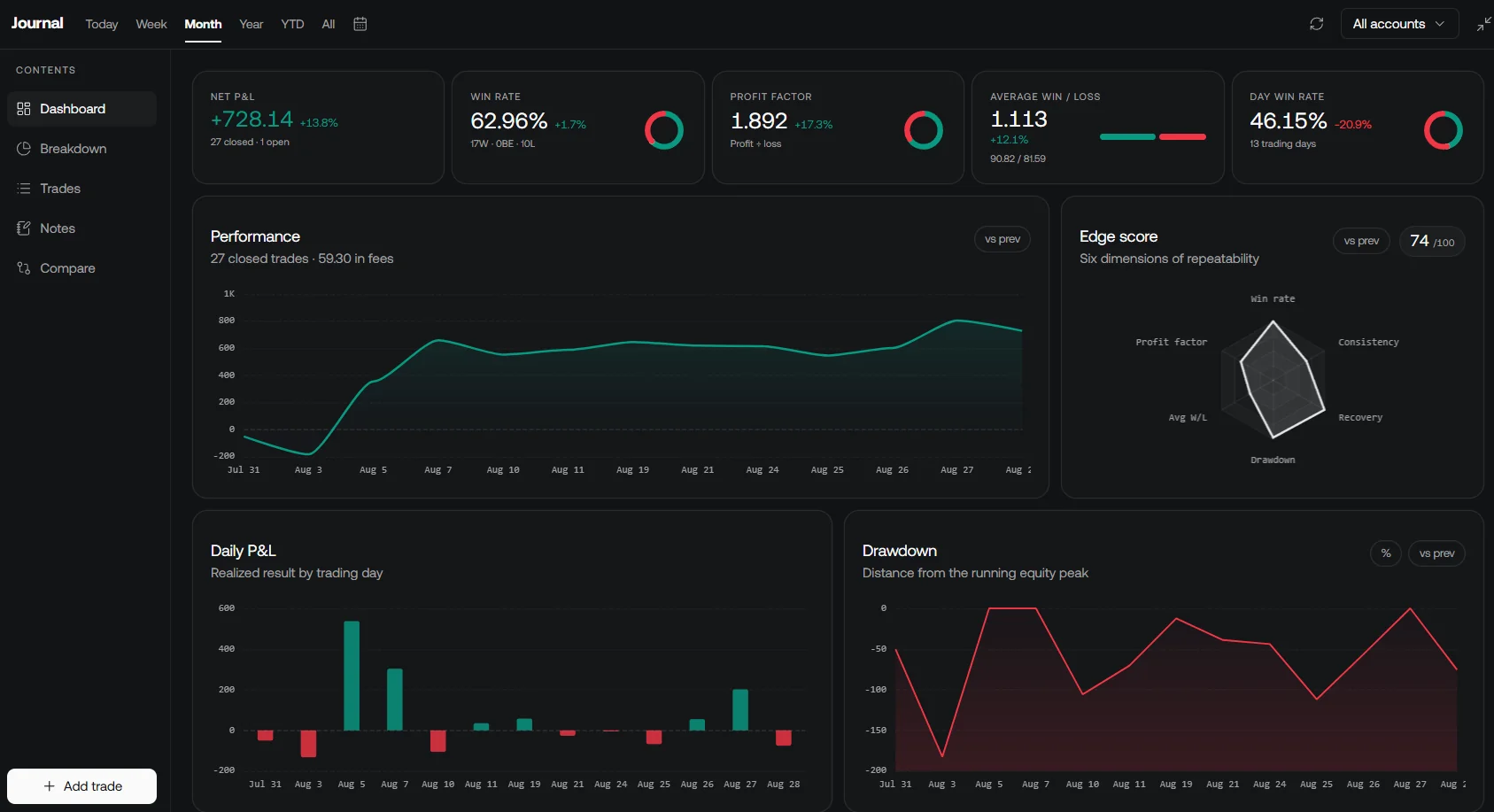
Keep the original hypothesis, data assumptions, test dates, parameter choices, and reasons for rejecting alternatives. The LuxAlgo Journal can help review recorded trading activity and performance. Reconcile imported or entered trades with broker records and retain separate research assumptions.
Separate Research from Deployment
Code generation, backtesting, alerts, and live order routing are different steps. Do not assume that generating a strategy automatically deploys it to a broker. FINRA’s algorithmic-trading guidance for member firms emphasizes development controls, testing, and supervision; it is a useful reference for the operational questions a deployment raises.
Before any live workflow, define exposure limits, behavior after a rejected or duplicated order, stale-data handling, and how trading stops during a fault. Compare paper-trading fills with the expected execution model. Test changes before deploying them and retain a known working version. These controls reduce avoidable errors; they do not make a losing strategy profitable.
Quantitative vs. Manual Trading
| Aspect | Systematic workflow | Discretionary workflow |
|---|---|---|
| Decision process | Rules are encoded and applied consistently | A person combines evidence and context at each decision |
| Research scope | Can evaluate many observations efficiently | Limited by attention, but can investigate unusual context |
| Execution | Speed depends on broker, data, and infrastructure | Depends on operator availability and workflow |
| Failure modes | Overfitting, data faults, correlated models, software errors | Inconsistency, fatigue, bias, and delayed action |
| Costs | Data, development, maintenance, and trading friction | Research time, oversight, and trading friction |
| Validation | Historical tests plus forward evidence | Written rules and records improve reviewability |
Automation can apply a bad rule consistently and quickly. Manual traders can use quantitative evidence, while systematic traders still make human choices about datasets, objectives, and risk limits. Neither method has an automatic claim to superior returns.
AI can accelerate drafting, coding, and analysis, but plausible explanations can contain errors. Let software perform defined tasks; keep people responsible for checking assumptions, deciding what evidence is sufficient, and authorizing changes. Banking productivity estimates do not establish a trading strategy’s expected profit.
What Traders Can Take from Simons
The durable lesson is a research discipline: gather reliable evidence, make assumptions explicit, challenge attractive results, and treat execution and risk as part of the strategy. Public accounts of Renaissance can motivate that process without revealing its private systems.
Investigate a market question on Vela, the charting platform we build at LuxAlgo. Then use Quant to build a reviewable prototype and test records to assess whether results hold up. Keep historical fund performance, hypothetical examples, and your own validated evidence clearly separated. A faster route from idea to code is useful only when the resulting decisions remain well supported.
Read next